


Thailand’s automotive sector represents a significant opportunity for companies seeking to expand in Southeast Asia. As the largest automotive manufacturing hub in Southeast Asia and the tenth largest hub globally, Thailand offers a unique combination of manufacturing expertise, strategic location, and growing electric vehicle (EV) transition opportunities.
As of November 2025, there are 46 million vehicles registered in Thailand of which 12.5 million are passenger cars.
Thailand’s automotive industry generates annual output exceeding 2 million vehicles, with a well-established supply chain and skilled workforce. The sector is undergoing a critical transformation toward electric vehicles and hybrid technologies, creating new opportunities for companies specialising in EV components, battery technology and sustainable manufacturing solutions.
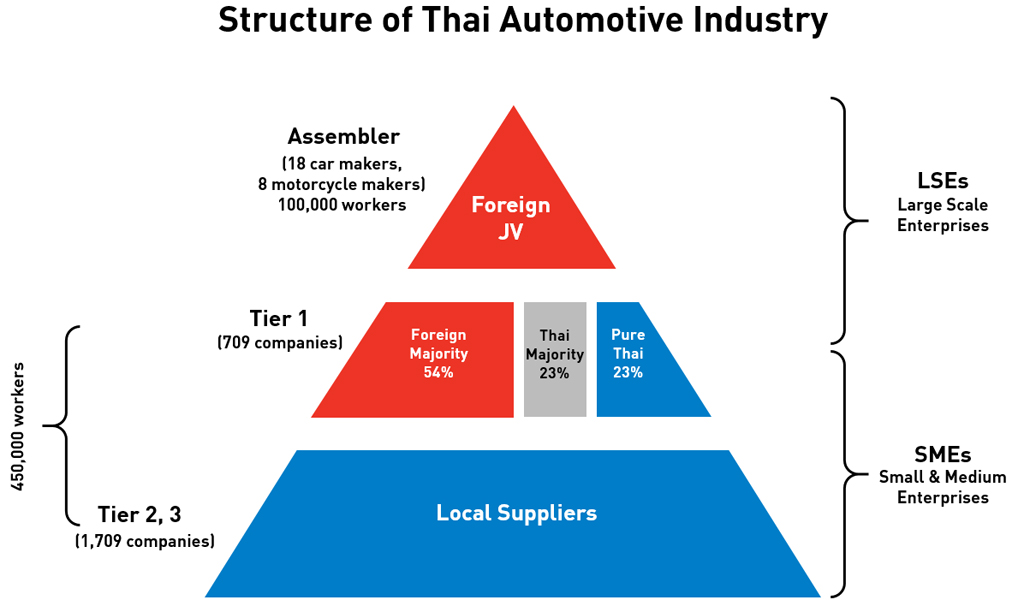
The automotive industry is a key industry for Thailand, accounting for approximately 12% of the country’s gross domestic product (GDP). At its peak in 2013, Thai automotive production capacity stood at 2.5 million vehicles and the industry employed over 550,000 people. Since then, the number of vehicles has decreased, but at the same time vehicles produced in Thailand have become more sophisticated. In order to develop Thailand as a global green automotive production base and promote automotive technology research and development, the government coordinated with the private sector to formulate the Master Plan for Automotive Industry. Thailand has approximately 700 Tier 1 auto-parts suppliers and 1,700 Tier 2 and 3 suppliers. More than half of the Tier 1 suppliers are automotive component companies. Of the top 100 auto parts manufacturers in the world, 50% have factories in Thailand. Thailand’s production base is diverse enough to supply all necessary components, from tires to structural components. Major multinational automotive industry leaders with presence in Thailand include: Auto Alliance Thailand (Ford and Mazda), BMW Manufacturing, General Motors, Hino Motor, Honda Automobile, Isuzu Motors, Toyota Motors, Mercedes-Benz Thailand, Mitsubishi Motors, Nissan Motors, Tata Motors, Suzuki Motor, and Volvo Car Thailand. As of 2025, vehicle exports have reached approximately 800,000 units in the first ten months, with EV exports gaining particular momentum.
Strategic Geographic Location: Thailand serves as the regional hub for automotive R&D and manufacturing for major global players. All corners of Asia are easily accessible from Bangkok, making it ideal for companies establishing regional operations. Bangkok’s Suvarnabhumi International Airport serves 60 million passengers annually, with direct flights to most European tier-1 cities and many tier-2 cities.
Competitive Advantages: – Corporate tax rate of 20%, the second lowest in the region – Access to ASEAN Economic Community (AEC) with 4 billion inhabitants and USD 24 trillion market size – free trade agreements with most Asia-Pacific countries, facilitating component sourcing – Over 70 well-functioning industrial estates with modern manufacturing facilities – Highly developed infrastructure and logistics networks
EV Transition Opportunities: With major Chinese EV manufacturers beginning exports from Thailand in 2025, the market is rapidly evolving. Companies with expertise in battery technology, electric drivetrains, charging infrastructure, and sustainable manufacturing processes are well-positioned to capture significant market share.