


The Bangkok metropolitan areas drive most of the electricity demand. However, there are also industrial and manufacturing bases in other provinces, also leading to an increased demand.
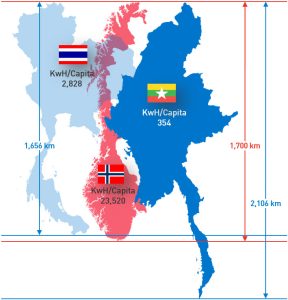 Thailand is currently heavily reliant on imported energy from neighbouring countries, particularly gas from Myanmar and hydropower from Laos. This fact has led the government to implement a national energy policy in order to reduce the dependency on imported energy. Consequently, Thailand has emerged as one of the first countries in Asia to encourage alternative energy investment. In 2015, in order to maintain the sustainability of energy in Thailand, the Ministry of Energy developed an Alternative Energy and Development Plan (AEDP 2015-2036), with the target of increasing alternative energy consumption from 7,413 ktoe (kilo tonnes of oil equivalent) in 2012 to 25,000 ktoe in 2021. The national power plan foresaw that biomass would have the largest share with 13% followed by PV 9%, wind 6% and hydropower with 5%. A further revision of this plan was drafted in 2018, but it was never approved. Then again another attempt was made in 2024 when it was expected that LNG as a world commodity would play a bigger role in the future with imports coming from Qatar, Australia and Indonesia. The plans included boosting the production capacity of Thailand’s only LNG terminal in operation from 5 million tons to 11.5 million tons annually and building a second terminal with a capacity of 7.5 million tons. By 2030 both should be running at full capacity. See further information in the Thailand Energy Report 2015, the last plan available in English.
The Thai language Draft 2024 Power Development Plan (PDP2024) is available from Thailand’s Ministry of Energy. We have taken the liberty of downloading the plan and prepared a summary translation of the various sections in case it becomes unavailable: